02/29/2024: UPGRADING THE APRON PAVEMENT WORK IN TRIESTE’S AIRCRAFT PARKING AREAS NEARS COMPLETION
Trieste Ronchi dei Legionari Airport, managed by Trieste Airport – Friuli Venezia Giulia, has undergone significant upgrading of the apron pavement.
The extraordinary maintenance work on the apron, involving the structural upgrading of the concrete pavement and the optimization of the stands, as well as the upgrade of taxiways “e” and “f,” lighting with new light towers and visual aids (AVL), is part of the four-year program of interventions planned by the airport management company afvg and approved by ENAC for the adaptation, strengthening, and improvement of the infrastructure at the Friulian airport.
The project, now nearing completion, was carried out over two successive winter seasons (2022-2023 and 2023-2024) to minimize its impact on airport operations.
The work was designed by Rome-based Tecno Engineering 2C Srl and then contracted to the Temporary Association of Companies Brussi Costruzioni Srl (lead agent) and Siem Srl (principal).
The rigid concrete surface of the aircraft apron, covering approximately 22,000 m2, was constructed by Ecovie Srl of Albignasego (PD), which, in the second phase of the project, used a new Wirtgen SP 64i slipform machine.
The essential requirements that airport airside infrastructure must meet, covering every technical, geometric, mechanical, and dimensional aspect, down to the color of each individual light fixture, are regulated by the ICAO for all airports in its member states (over 190). Their aim is to ensure high and uniform safety standards, regardless of the airport’s size and the volume of air traffic, whether passenger or cargo.
When designing aircraft aprons, it is therefore necessary to meet stringent quality standards regarding load-bearing capacity, grip, surface smoothness, and pavement durability.
Airside structures subjected to significant static and dynamic loads must maintain excellent grip and surface smoothness throughout their entire “useful life,” respecting the longitudinal and transverse profiles characterized by modest slopes necessary to ensure the drainage of platform rainwater.
Good surface characteristics for parking areas can only be achieved and maintained over time through meticulous planning and direct, supervised implementation by experts who pay attention to detail and are capable of using increasingly efficient and modern technologies and machinery for paving, such as those we’ll discuss later in this article.
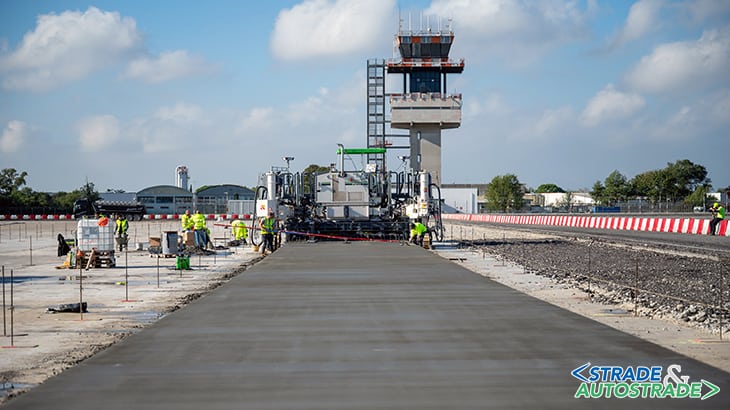
The slab after automatic finishing.
More information at the following link: https://www.stradeeautostrade.it/pavimentazioni-e-manti/pavimentazioni-rigide-per-le-aree-di-sosta-allaeroporto-di-trieste/
Technical data relating to the paving project
Client: Aeroporto Friuli Venezia Giulia SpA a S.U.
RUP: Eng. Marco Consalvo of AFVG
Safety coordinator during construction: P.H. Infrastructure and Systems Design and Maintenance: Stefano Guerriero of AFVG
Senior Supervisor: Flavia Bellacicco of ENAC
ENAC Testing and Usability Committee: Francesco Pulice (Chair) and Maria Grazia Bellizzi (Member)
Design, CSP, and Construction Management: Tecno Engineering 2C Srl
Designer, CSP, and Construction Management: Carlo Criscuolo of Tecno Engineering 2C Srl
Operations Manager: Domenico Terra of Tecno Engineering 2C Srl
Contractor: Temporary Consortium composed of Brussi Costruzioni Srl (Leading Company) and Siem Srl (Principal)